
Simulation
More games to drift through
Swap tabs in seconds and keep the momentum going with another arcade favorite.
Simulation

Simulation

Shooting

Simulation

Adventure

Simulation

Action

Adventure
Simulation

Hypercasual
Puzzle

Simulation

Action

Adventure

Hypercasual
Action
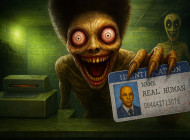
Investigate IDs, spot impostors, and survive co-op nights in Skinwalker Game with randomized shifts, smart traps, and escalating gas-station horror.
Skinwalker Game drops you into a dusty 1990s roadside gas station and asks you to do a job that sounds simple: serve customers, check IDs, and keep the register moving. The twist is that some visitors are not human. In this game, shapeshifting impostors can copy faces, clothing, and even small habits, then slip through your routine like a bad receipt you forgot to scan. The station feels ordinary for a moment, and then Skinwalker Game turns every “hello” into a threat assessment.
What makes Skinwalker Game so tense is the rhythm of its loop. You alternate between calm, procedural verification and sudden, panicked survival. One minute you are comparing an ID card to a computer record; the next, the wrong call means an intruder is loose and you have to barricade doors, place traps, and hide with your teammates. Skinwalker Game rewards players who slow down, notice tiny inconsistencies, and communicate clearly under pressure.
At its core, Skinwalker Game is an investigation-and-defense horror experience. You are an attendant on duty, and the station becomes your workplace, your puzzle board, and your battlefield. Skinwalker Game focuses on short, high-stakes decisions rather than long tutorials: identify the visitor, decide whether to let them pass, and prepare for consequences when you are wrong.
At the heart of Skinwalker Game, every customer arrives with information you can cross-check. You will look at documents, compare names and numbers, and confirm details against what the station systems show. When Skinwalker Game is running smoothly, you are doing “paperwork horror”: calm checks that still feel scary because you know a single mistake can end the shift.
Documents can be forged, but patterns are harder to fake. Skinwalker Game pushes you to watch movements, dialogue, and timing. Does a guest hesitate when you ask a basic question? Do they contradict what their card says? In this game, those micro-signals are often the difference between safety and catastrophe.
Skinwalker Game leans on randomness to keep you uneasy. Layout changes, routes shift, and the way visitors approach can feel different from one run to the next. That means memorizing one perfect route is less valuable than building a solid process. Skinwalker Game is at its best when your team creates a repeatable checklist and then adapts when the station surprises you anyway.
If you misjudge a visitor in Skinwalker Game, the tone flips. The impostor can escape the counter area and the night becomes a scramble for survival. Doors must be closed, exits blocked, and the team has to decide whether to hold a room, rotate positions, or bait the threat into a trap. Skinwalker Game becomes a cooperative war of seconds, where a calm voice on comms can matter as much as quick movement.
When Skinwalker Game turns hostile, start with control. Close what you can, limit angles, and keep sightlines short. The best teams in this game assign someone to watch the main approach while others handle traps and a fallback plan. Your goal is not to “win fast” but to survive the shift through disciplined positioning.
Skinwalker Game hints at defensive tools that reward teamwork. A trap placed too early might be wasted, while a trap placed too late might never activate. In this game, coordination is the multiplier: one player lures, one blocks, and one watches a secondary route so the group does not get flanked.
Although Skinwalker Game can be played solo, the design shines with two or three players. You can split tasks and reduce mistakes, and you can also create roles that keep communication clean. Skinwalker Game is stressful when everyone talks at once; it becomes manageable when each person knows their job.
The checker in Skinwalker Game owns the documents. They read IDs, compare numbers, and keep a mental list of anything suspicious. This role benefits from patience and a habit of speaking in short, clear sentences. In this game, the checker is the team’s anchor.
The gatekeeper in Skinwalker Game controls movement through doors and chokepoints. They focus on physical security: when to open, when to deny, and where to stand if a visitor tries to push through. A steady gatekeeper in Skinwalker Game prevents chaos when tension spikes.
The stabilizer in Skinwalker Game watches the room and the team. They call out odd behaviors, track time pressure, and remind everyone of the plan. During a breach, the stabilizer in this game helps the group regroup instead of scattering.
Skinwalker Game is still evolving, so some mechanics may change as development continues. Even so, the core interactions are easy to understand: inspect, audit, compare, and decide. Skinwalker Game uses familiar horror-game language—interact with objects, review data, and move with urgency when danger is confirmed.
Expect to use station tools such as record systems, transaction identifiers, and observation prompts. Skinwalker Game encourages you to “work the problem” like a real attendant: verify the facts, then verify the person. When things go wrong, this game asks you to act like a survivor: close distance, deny routes, and keep calm.
Skinwalker Game is harsh to impatient players. If you rush, you will miss details, and the game will punish you with a breach that feels deserved. Treat Skinwalker Game like a checklist simulator wrapped in horror, and you will improve quickly.
In Skinwalker Game, do not rely on a single detail. Confirm at least two independent facts before you decide. For example, match an ID number to a record, then confirm a behavioral cue or a location detail. This game becomes less random when you use a consistent verification pattern.
When Skinwalker Game offers dialogue checks, keep them basic. Simple prompts make it easier to spot contradictions. Skinwalker Game likes to hide the impostor behind “almost correct” responses; your job is to find what does not fit.
Use short callouts in Skinwalker Game: “Mismatch,” “Green,” “Hold door,” “Trap ready,” “Fallback.” The more precise your words, the less panic you create. Skinwalker Game is loud when everyone is scared; your comms should be quiet and useful.
When the threat is out, Skinwalker Game tempts you to run after it. Instead, focus on containment. Block exits, reduce options, and move as a unit. Skinwalker Game rewards teams that think like defenders, not hunters.
Skinwalker Game sits at the intersection of social deduction and survival horror. It delivers the satisfaction of spotting an inconsistency and the adrenaline of living with your mistake. Because the station can change and encounters can vary, Skinwalker Game stays replayable even when you understand the general idea.
If you enjoy games where observation matters—where a tiny line on a document can save you—Skinwalker Game will feel like a focused, high-pressure version of that fantasy. And if you prefer co-op tension, this game gives you a reason to coordinate without turning the experience into pure shooting.
Start Skinwalker Game with a conservative mindset. Your goal is not speed; it is accuracy. In the first few runs of Skinwalker Game, spend extra time learning what “normal” looks like: normal IDs, normal behavior, normal station flow. Once you understand the baseline, Skinwalker Game becomes a game of exceptions.
Next, establish a simple team protocol. In Skinwalker Game, decide who speaks first, who confirms, and who makes the final call. If you rotate responsibility each shift, you will also learn the whole system faster. Skinwalker Game is easier when your team agrees on process more than personality.
1) Checker reads the ID summary aloud. 2) Stabilizer compares the record and watches behavior. 3) Gatekeeper decides the door action. This structure keeps Skinwalker Game from turning into argument, and it helps you recover faster after a bad call.
Skinwalker Game can be played online through an embedded demo on some browser game hubs, and you may also see a single-player demo mentioned by the community. If your page hosts the embed, you can launch Skinwalker Game instantly in the browser.
Begin by welcoming the first visitors, then verify documents, records, and behavior before you allow entry or deny service. If you misjudge in Skinwalker Game, trigger lockdown habits: block exits, place traps, hide with intent, and survive until the shift ends.
Skinwalker Game works solo if you enjoy slow, methodical checking, but co-op is where the tension spikes and the strategy shines. With friends, Skinwalker Game becomes a communication test that feels different every night.
Focus on consistency. The best way to get better at Skinwalker Game is to use the same verification checklist each time, then adjust only when you find a new kind of inconsistency. Skinwalker Game rewards calm repetition more than risky improvisation.
Need help with Those Nights At Fredbears? Visit the Help Center or contact us through the support page.