
Simulation
More games to drift through
Swap tabs in seconds and keep the momentum going with another arcade favorite.
Simulation

Action
Puzzle

Hypercasual

Puzzle

Simulation

Survival

Puzzle

Simulation
Arcade

Action

Simulation

Arcade

Puzzle

Puzzle
Action
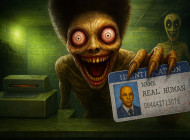
Survive the night shift in Skin Walker or Not online by checking IDs, spotting impostors, and setting traps when horrors break in—solo or co-op.
Skin Walker or Not drops you into a lonely roadside gas station in a gritty 1990s setting, where your “normal” job—selling snacks, checking IDs, and keeping the lights on—slowly turns into a paranoid survival test. In Skin Walker or Not, strangers arrive with paperwork, attitudes, and tiny tells that can expose them as something else. Your goal is simple to say and hard to execute: keep the store running, identify who is real, and stay alive when a fake slips through.
What makes this experience addictive is the constant tension between routine and panic. One minute you are scanning an ID and typing details into a computer; the next you are deciding whether to open the door, ask one last question, or slam a barricade down because the “customer” is staring too long. Skin Walker or Not rewards careful observation, quick judgment, and calm under pressure, especially when you play with friends and every decision becomes a debate.
Skin Walker or Not builds dread with small details: flickering lights, lonely roads, late-night radio vibes, and the feeling that the station sits far beyond help. You are the night clerk on a remote route, and the outside world feels distant—just you, the counter, and a line of people who may not be people at all. The plot isn’t delivered through long cutscenes; instead, Skin Walker or Not lets the story emerge from the nightly loop: different IDs, different moods, and the slow realization that “normal” rules stop working after midnight. Each visitor is a small story, and each small story can turn into a threat if you miss what’s off.
As nights pass, new patterns and surprises appear. Visitors can act friendly, impatient, confused, or hostile, and you must decide whether they are simply odd… or dangerous. Because Skin Walker or Not leans on replayable nights rather than a fixed script, the station can feel different every session, keeping you alert even after you think you “know” what to look for.
The main job in Skin Walker or Not is verification. Visitors present an ID, and you compare names, photos, and details to what you can confirm on your computer. The truth usually hides in tiny mismatches: the wrong date, an inconsistent address, a photo that feels off, or a response that doesn’t align with the record.
When you suspect someone, Skin Walker or Not lets you ask a limited set of questions. Those questions are powerful because they force the visitor to commit to details. If the answer is delayed, strange, or contradictory, Skin Walker or Not is telling you to trust your instincts—and your evidence.
Skin Walker or Not is not only an “ID check” game; it is an observation game. Pay attention to eye contact, posture, pacing, and the way a visitor reacts when you hesitate. The game often signals danger through subtle social friction: too much confidence, oddly flat emotion, or impatience that escalates when you start checking deeper.
Some fakes in Skin Walker or Not imitate the surface details well, so the best habit is to build a quick mental checklist. Does the face match the card? Does the mood match the story? Do the small habits feel human? In Skin Walker or Not, consistency is safety.
Every shift in Skin Walker or Not funnels toward decisions. If you admit a fake, you may trigger an assault. If you deny a real customer, you lose trust, time, or resources. This design means perfect certainty is rare—your skill is making the best call with imperfect information, then reacting fast when you are wrong in Skin Walker or Not.
Once the station is threatened, Skin Walker or Not shifts from detective work to survival. Doors become chokepoints, aisles become hiding lanes, and your earlier choices about supplies suddenly matter. In this phase, you can barricade entrances, place bear traps, and use light or noise to read the creature’s movement. Skin Walker or Not turns the store into a compact arena that forces you to think like prey and plan like a defender.
Stealth is often smarter than ego. You have options—run, hide, trap, shoot—but the best choice depends on what you bought and where you positioned yourself. Because attacks can happen after a single mistake, Skin Walker or Not pushes you to survive first and “win fights” second.
Between customer rushes, Skin Walker or Not becomes a planning game. You can rearrange goods, accept deliveries, and decide how to spend your limited budget. Here, your wallet is a weapon: ammo, traps, reinforcements, and utilities all compete for the same money.
Smart players treat Skin Walker or Not like a nightly investment puzzle. If you overspend early, you may have no response when the worst case arrives. If you hoard too much, you might miss upgrades that make later shifts safer. The sweet spot is balancing caution with preparation, using each shift in Skin Walker or Not to build a sturdier, smarter defense plan.
Skin Walker or Not supports 1–3 players, and co-op is more than just “extra hands.” With a small team, the station turns into a communication test: one person compares IDs, another checks the computer, and a third watches body language. When things go bad, Skin Walker or Not rewards clear role swaps—one player sets traps, another covers angles, and someone tracks exits.
The best co-op sessions feel like a tense tabletop debate. You share suspicions, argue over evidence, then commit to a decision together. That shared responsibility is the magic: Skin Walker or Not makes the room louder, funnier, and scarier at the same time.
Skin Walker or Not keeps controls familiar so the pressure comes from decisions, not keybinds. Move with W/A/S/D, look with the mouse, and interact or use the computer with E. Sprint with Shift when you need distance, crouch or sit with Ctrl when hiding matters, and use the flashlight or tools with F. If it escalates to combat, shoot with the left mouse button and reload with R. Open settings with ESC when you need to pause, tweak sensitivity, or review options.
A typical night in Skin Walker or Not follows a clean loop: serve customers, verify IDs, observe behavior, decide who is fake, then restock and prepare. When an assault happens, Skin Walker or Not becomes a short, intense survival sequence where your preparation gets tested immediately.
In Skin Walker or Not, speed comes from repetition. Start with the same order every time: photo, name, date, then cross-check in the computer. A consistent routine reduces mistakes, and Skin Walker or Not punishes sloppy checks more than slow checks.
Because Skin Walker or Not limits how much you can interrogate, save questions for moments where an answer will change your decision. Ask for details that must match the record. If the visitor dodges, stalls, or shifts tone, Skin Walker or Not is flashing a warning sign.
Traps in Skin Walker or Not are strongest when they shape movement, not when they are scattered randomly. Put them at corners, narrow aisles, or near doors where you can predict a path. Think of Skin Walker or Not like a tiny tower-defense map: you want to control routes.
New players try to fight too often. Skin Walker or Not makes stealth viable because surviving is the objective. If you cannot guarantee a clean shot or safe route, hide, listen, and wait. Patience pays off in Skin Walker or Not when the station turns hostile.
In Skin Walker or Not, one weird detail is not always proof. Instead, look for clusters: an ID mismatch plus an odd voice plus an unnatural reaction. When multiple signals stack, Skin Walker or Not gives you enough confidence to act.
During attacks, Skin Walker or Not lets you interpret movement through audio cues and environmental changes. Turn your flashlight on and off to check space quickly without becoming an easy target. Make noise intentionally to bait motion, then reposition. Skin Walker or Not becomes a cat-and-mouse problem where information is survival.
Resource planning in Skin Walker or Not is about insurance. Keep enough funds for emergency reinforcements and a defensive item you can deploy instantly. Skin Walker or Not often feels “easy” until it suddenly doesn’t, and the shift that breaks you is usually the one you underprepared for.
When you play Skin Walker or Not with friends, avoid vague panic. Call out facts: “photo mismatch,” “wrong address,” “refused to answer,” “door left side.” Co-op runs in Skin Walker or Not become smoother when everyone shares evidence, then assigns tasks fast.
Rushing the check: Skin Walker or Not punishes speed without process. Slow down, follow your routine, and you will make fewer fatal calls.
Overtrusting charm: Some visitors in Skin Walker or Not feel normal on purpose. Trust the documents and the database, not the vibe.
Ignoring positioning: If an assault begins, Skin Walker or Not becomes a game of angles. Standing in the open is an invitation; always know your nearest cover, exit, and fallback point.
Buying without a plan: Skin Walker or Not tempts you with gear. Spend based on how you defend: traps for funnels, ammo for confident shooters, reinforcements for chokepoints.
Skin Walker or Not combines social deduction, horror tension, and practical survival in one tight loop. The “night shift” premise makes every interaction feel grounded, so the supernatural intrusion hits harder. It also thrives on replayability: different nights, different behaviors, and different mistakes to learn from. Whether you want a solo paranoia challenge or a co-op scare-fest, Skin Walker or Not gives you reasons to keep returning for “one more shift.”
If you enjoy games where observation matters as much as reflexes, Skin Walker or Not is an easy pick. It turns ordinary paperwork into suspense, and it turns a small store into a battlefield the moment you let the wrong guest inside. Start a run, trust your checklist, and see how long you can keep the station safe in Skin Walker or Not.
Need help with Those Nights At Fredbears? Visit the Help Center or contact us through the support page.